Higher reps!
Increasing your repetitions is one of the many ways to get more from your workouts. As some of your muscle fibers get tired with the first few reps, your body must continually recruit more and more fibers the more repetitions of an exercise you do. Some suggestions:
- Really work the muscle to failure, not just to the point where it's kind of unpleasant to lift the weight again. Failure means that you CANNOT move the weight, despite you best effort!
- Super-set a smaller muscle group immediately after a large group in at the end of your workouts. For instance, sometimes I'll do a dumbbell chest press and then move directly into kickbacks.
- If it really starts to burn too much or you have an achy joint. Stop for a few seconds and then finish five more reps.
Expect to advance and succeed. Research shows that optimism and visualization of success significantly improve athletic performance; this is something I practiced before I even realized research was done on such topics!
- Don't settle for little weights; you are strong and can do more, even if it's only 2.5 or 5 lbs more! Certain parts of your muscle will never be challenged if you don't take the weight up every so often! This will mean fewer reps and more rest between sets on you heavy lifting days!
- Choose to go up in weight and actually see yourself effortlessly cranking out 10 reps-- see it and then DO IT!
Attention--pay attention to the muscles that you are working! I see way too many ballistic lower back exercises disguised as bicep curls in the gym! What muscle are you working? Are you getting a full range of motion?
- Close your eyes, ignore the hottie next to you and your own reflection, and actually feel which muscle you are working!
- Most muscle damage is done on the way down (eccentric); the rep is not finished until you reach the bottom, so keep the weight controlled and focus on the movement until your weights are in the starting position again!
- How is your range of motion? For example, on bicep curls (easy target) are your arms fully extended at the beginning or is there still an angle in your arm? Do you reach a full contraction at the top; do you extend all the way down again?
Time between sets. Reducing the time between sets is another highly effective may to intensify workouts!
- Actually time how long you are taking between sets; reduce that amount of time by 30 second or a minute when you want to intensify your workout!
- Do not get into conversations when you are working out; it's okay to be a little cold. During your workout, it's down to business!
In essence, you can intensify your workouts by adding 1) more reps (or overall volume); 2) heavier weights; 3) and reducing time between sets. But none of these strategies will help if the exercises are not performed effectively!
Monday, November 26, 2007


Friday, November 23, 2007
How (Pseudo) Sweet it is: Artificial Sweetener Review

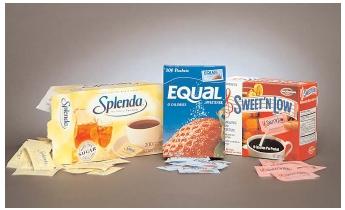
So what's sweetening your toothpaste? I'll give you a hint; it's NOT sugar! Even if you avoid artificial sweeteners, you have have hidden sources in your diet! Below is a review of the artificial sweeteners that are currently available for use in the US, including; what they are, where they come from, uses, and where they go in your body!
Artificial sweeteners that come in packets contain mostly starch filler- all artificial sweeteners are much sweeter than sugar (hundreds or thousands of times sweeter). If manufacturers didn't add starch to the packet, you wouldn't be able to see the sweetener- try adding that to your coffee ;)
Saccharin (Sweet N' Low/pink packet)
- 500-600 X sweeter than sugar
- First artificial sweetener, invented in 1879
- Approved by FDA for human use
- Many taste bitterness
- Mostly used in packet form and as pharmaceutical additive
Artificial sweeteners that come in packets contain mostly starch filler- all artificial sweeteners are much sweeter than sugar (hundreds or thousands of times sweeter). If manufacturers didn't add starch to the packet, you wouldn't be able to see the sweetener- try adding that to your coffee ;)
Saccharin (Sweet N' Low/pink packet)
- 500-600 X sweeter than sugar
- First artificial sweetener, invented in 1879
- Approved by FDA for human use
- Many taste bitterness
- Mostly used in packet form and as pharmaceutical additive
"Anybody who says saccharin is injurious to health is an idiot"
-President Theodore Roosevelt
Concerns about saccharin developed several years ago after rats that were fed massive amounts of saccharin developed bladder cancer. On the other hand, anything in massive amounts will kill you or give you cancer. For instance, mega-dosing Vitamin C increases your risk of cancer; beta-carotene consumed in reasonable levels increases the risk of cancer in smokers; marathoners are far more likely to die of over-hydration than dehydration. The point is that saccharin consumed in reasonable amounts (a few packets a day) is well within the approved safety zone. It's been around for over a hundred years, so saccharin has the history to back up its general safety. I can't taste the bitterness in saccharin and it's super-cheap, so it is my artificial sweetener of choice.
-President Theodore Roosevelt
Concerns about saccharin developed several years ago after rats that were fed massive amounts of saccharin developed bladder cancer. On the other hand, anything in massive amounts will kill you or give you cancer. For instance, mega-dosing Vitamin C increases your risk of cancer; beta-carotene consumed in reasonable levels increases the risk of cancer in smokers; marathoners are far more likely to die of over-hydration than dehydration. The point is that saccharin consumed in reasonable amounts (a few packets a day) is well within the approved safety zone. It's been around for over a hundred years, so saccharin has the history to back up its general safety. I can't taste the bitterness in saccharin and it's super-cheap, so it is my artificial sweetener of choice.
Sucralose (Splenda/yellow packet)
- 320-1000 time sweeter than sugar
- A derivative of table sugar (the disaccharide sucrose), approved by the FDA in 1998
- Available in packet form and is increasingly added to foods
- bars, diet and non-diet drink mixes, cocoa mixes, coffee drinks, sugar-free sports drinks, yogurt, sodas, many other foods
- Probably the best tasting
- Sort-of heat stable
Sucralose has enjoyed immense popularity since its introduction in the late 1990s. Our tongues sense sweetness when the electronegative groups of sweet substances bind to receptors in our taste buds- sometimes this sensation goes horribly wrong when the artificial sweeteners structure is a little off or also activates bitter receptors. Sucralose has less of this problem because the developers kept most of the structure the same as sugar, but just knocked off a couple parts and replaced them with chloride, another electronegative group. Because of this change, our highly specific intestinal enzymes cannot break it down sucralose passes through the digestive tract without changing. I like sucralose and I use it sometimes, but saccharin has a longer history and is less expensive.
Aspartame (Equal/NutraSweet/blue packet)
- FDA approved for some uses in 1983
- 180 times sweeter than sugar
- Two amino acids bound together
- Those with PKU (phenylketonuria) cannot have aspartame
- Used in packets, most diet sodas, many diet drinks, and some other foods
Let me just take this opportunity to explain why the PKU warning on aspartame products does not apply to you. PKU is an inherited disease, which is tested for at birth. The individuals with this condition are lacking an enzyme that allows the body to convert excess phenylalanine, the essential amino acid, to tyrosine. As a result, toxic levels of phenylalanine accumulate and the person becomes mentally retarded. People with PKU have to drink elemental (no real whole food ever) formulas to get their nutrition.
That said, though aspartame is fully approved for food use and considered safe by the government, some people report headaches when they have it. Furthermore, a break-down product of aspartame is formaldehyde, a highly toxic substance. Though the levels of formaldehyde produced are very tiny, do you really want it there at all? I don't. So though it is officially safe, I do limit the amount of aspartame in my diet.
Acesulfame Potassium (K)
- 100-200x sweeter than sugar
- Found in a huge number of food products, very common in sports nutrition products, drinks
- Often used in combination with other sweeteners
Neotame
- 8000-13,000 times sweeter than sugar
- Approved in 2002, not used much in this country
- I found it in a packet in combination with Acesulfame K; it wasn't too bad
- 8000-13,000 times sweeter than sugar
- Approved in 2002, not used much in this country
- I found it in a packet in combination with Acesulfame K; it wasn't too bad
Cyclamates
- 30-50 times sweeter than sugar
- Not approved for use in USA, used as part of "sugar twin" in Canada
- Once I smuggled some over the border and felt all scandalous
- 30-50 times sweeter than sugar
- Not approved for use in USA, used as part of "sugar twin" in Canada
- Once I smuggled some over the border and felt all scandalous
Stevia
- 250-300 times sweeter than sugar
- Most common natural non-nutritive sweetener
- Not approved for food use in US
- 250-300 times sweeter than sugar
- Most common natural non-nutritive sweetener
- Not approved for food use in US
Many people like the idea of using Stevia because it comes straight from a plant and has less impact on blood sugar than some other sweeteners, which is probably due to the fact that it tastes very little like sugar. In my opinion, its lack of sugar taste makes it a poor choice for use as a sweetener. It kind of has a weird tingly thing going on- I've often heard in reference to drinks made with Stevia "It's got something in it- its weird- I can't decide if it's gross." On the other hand, many people like it because it's sort-of heat stable, and it is a natural product. It is not approved for food use because of some apparent concerns about its potential to be a liver carcinogen, but the evidence is inconclusive. Most likely, no one is willing to fund the research for Stevia because it doesn't taste very good and it may not produce good returns as an investment, since there are currently many adequate sweeteners. You can buy the refined powder as a "supplement" in the US, however.
Sugar Alcohols
- About as sweet as sugar
- Roughly half as many calories as sugar
- I am anti-sugar alcohol
- Used in many "sugar-free" "low 'net carb"' products
- About as sweet as sugar
- Roughly half as many calories as sugar
- I am anti-sugar alcohol
- Used in many "sugar-free" "low 'net carb"' products
Wait a second while I climb onto my soap box. Okay, here we go. There are many different kinds of sugar alcohols made from different kinds of sugar, basically just one chemical group is changed- some of the sugar alcohols can be absorbed better than others- all are converted to regular sugar or used as energy when they are absorbed.
The two main issues that I have with sugar alcohols are the following 1) They will give you nasty stomach pain, bloating, and gas in large amounts (bars that have them contain them in large amounts) 2) They totally still count as carbohydrates and are not healthier than sugar.
Sugar holds water. Sugar alcohols also hold water. Sugar alcohols have ½ the calories of sugar because they only absorbed about half way, as such the sugar alcohols that are not absorbed hold water in your intestines and the unused carbohydrates are worked on by the bacteria in your large intestine- all of this leads to massive bloating and abdominal unrest. If you do not experience this problem, it means that you have absorbed all of the sugar alcohols, and the calories in the product are essentially the same as sugar. The bottom line is that after eating a product that is high in sugar alcohols you are either 1) bloated and unhappy or 2) consuming a lot of processed carbs that are absorbed and used by the body. If you have unexplained stomach pain, you should 1) stop chewing so much gum 2) stop eating sugar-free hard candy 3) double check the ingredients of your favorite bar for sugar alcohol, "other carb", xylitol, sorbitol or one of the other many "ol" compounds and eradicate them from your diet. Rant over.
In short, sugar substitutes can be useful used in appropriate amounts. Furthermore, there is a noted "synergistic effect" when substitutes are combined, which results in a product that tastes more legitimately sweet. Among all, I would stick to saccharin (sweet n' low) and sucralose (splenda) for your sweetening needs.
Wednesday, November 21, 2007
Protein-Packed "Pumpkin" Pie

I have a massive sweet tooth; I love pie! These truths are what led me to eat not one, but two and a half, entire pies one Thanksgiving. It was quite a nasty aftermath!
As such, I was motivated to create a pie recipe that was not a total heart attack in a Pyrex dish. From that vision, the recipe below was born! Enjoy!
"Pumpkin" Pie
Pre-heat oven to 350 F
Ingredients
1 graham cracker crust
2 cups slow-cooked, skinned sweet potatoes (yams), not packed
1 cups low-fat cottage cheese
1 cup low-fat (1%) milk
2 large eggs
1 teaspoon vanilla
1 tablespoon molasses
2 1/2 teaspoons cinnamon
1 teaspoons nutmeg
1/2 teaspoon powdered ginger
1/4 teaspoon cloves
1 1/2 packets of "pitcher mix" splenda (1 packet = 1 cup sugar sweetness)
Instructions:
1. Combine all of the ingredients, except for the crust, in a food processor.
2. Process until completely smooth
3. Pour mixture into crust and bake for 40-45 minutes or until the center is not gooey
4. Allow to cool completely in the fridge.
Serves 8
Nutrition: 210 Calories; 8 g protein; 29g carbs; 2g fiber; 7g fat
~ As a alternative no-bake pie type thing, omit 1/2 cup milk and the eggs and add to the crust
~ This recipe is a little over-spiced, mostly to compensate for the lack of sugar; you may prefer a little less spice
~ To cut the fat grams, use fat-free cottage cheese and milk; you may also make your own graham cracker crust with only 2 Tbsp of butter for the whole pan (that'll give you about 2-3g of fat from the crust vs. 5g); you may also make the no-bake version and add a crumbled graham cracker to the top
~ To cut the carbs, eat only the no-bake pie custard without the crust or try canned pumpkin instead of the sweet potatoes!
~ For added sweetness, try sprinkling a little Sweet N' Low Brown to the top of the baked pie :-)
Monday, November 19, 2007
HEALTH: 6 Ways to Nourish the Body with Food
1. Holistic
Food choices should be “close to the source,” which means that they should be mostly unprocessed. For instance, fresh turkey breast is a holistic food; 96% lean turkey deli meat is not. Even though the deli turkey is lean, it has been through a factory, exposed extensively to preservatives and chemicals; hence, it is not the best choice for your body.
In like manner, grains like brown rice and old-fashioned rolled oats are healthy, but 10-minute brown rice and instant oatmeal are weak choices. The carbohydrates need to be included in your diet, but it is essential to get them in a whole form!
In terms of fruits and vegetables, fresh and frozen, with no sugar or salt added, are good options.
Low-fat, no salt added cottage cheese = good; Velveeta = bad
2. Equilibrium in nutrients and food groups
Nutrients include all food components that are required to keep your body healthy and alive. Vitamins and minerals are nutrients, as are carbohydrate, fat, and protein. It is important to ensure that a minimal amount of all nutrients are taken over the long term. As a very general rule of thumb, you need the following as a minimum in your diet: 125g carbohydrates (the minimum required by organs); 0.5g protein/lb body weight (just a little about the current RDA); about 35g fat (consisting mostly of unsaturated fats). Your diet will likely include even more carbohydrates, protein, and fat, but the point is that a healthy diet does not eradicate any given component!
Eat a variety of foods and colors to ensure dietary equilibrium. A mark of a healthy diet is one that does not restrict specific kinds of food groups. For instance, grain, dairy (low-fat), nuts, and meat (lean) are all good to eat. Highly processed packaged and fried foods don’t really fit into a group, so they should not make up a significant part of your diet!
3. Adequate Volume and Calories
Nourishing a healthy body and/or building muscle requires adequate calories. The brain receives signals based on the dietary energy level and content, which, in turn, affects immune function, hormone release, and countless bodily functions.
Your body will give you several warning signs if you dietary energy level is too low. For example a sudden drop in heart rate, feeling freezing cold all the time, brittle hair and nails, aging quickly and exceedingly dry skin all may indicate that you are being too restrictive. In this case, your efforts to loose weight or become healthier are completely counter-productive because your body is trying desperately to conserve fuel; i.e. your metabolism is moving a crawl and your calorie-burn is low. Eat enough energy to build yourself and maintain the stamina needed for an action-packed life!
4. Loaded with Energy Early in the Day
Studies prove that breakfast eaters are less likely to be overweight. Also, “breaking the fast” is important to maintain lean mass; eating is the first thing on my mind when I wake up!
In general, I tend to have about ½ to 2/3 of my daily calorie intake eaten by the end of my “lunch” meal.
5. Timed Properly
Eating one colossal meal per day is unacceptable; many people follow this pattern; skip breakfast; muffin at lunch; enormous unhealthy dinner. This method is a recipe for guaranteed failure.
Some nutritionists believe that everyone needs 6-8 “meals” per day. This rule is kind of silly; different people respond better to different eating frequencies. I personally do eat 6-8 mini-meals per day; however, some people have enough trouble eating four times a day.
In short, you need to eat balanced meals containing protein, carbohydrate, and fat, which are spaced evenly apart, at several times points during the day. Protein and carbohydrate give the body anabolic signals, which will help you maintain lean mass as you go throughout your day; fat is needed to absorb all fat soluble vitamins (A, D, E, K) and at least 5-10g should be taken in at each meal.
6. Hits the Spot
Some people “eat to live.” But that sure doesn’t describe me! Food should not be selected purely based on function. To some extent, eating whole, natural foods is an acquired taste, but you will develop the taste for it! So experiment and find healthy foods that are satisfying to you!
Also, some foods have no real redeeming nutritional value, but are still important to have every now and then for satisfaction (e.g. my occasional DQ splurge)!
_____________________________________________________________________
Healthy eating habits are not developed overnight, so try every day to eat what is best for your body. In time, healthy eating will be intuitive and enjoyable!
Food choices should be “close to the source,” which means that they should be mostly unprocessed. For instance, fresh turkey breast is a holistic food; 96% lean turkey deli meat is not. Even though the deli turkey is lean, it has been through a factory, exposed extensively to preservatives and chemicals; hence, it is not the best choice for your body.
In like manner, grains like brown rice and old-fashioned rolled oats are healthy, but 10-minute brown rice and instant oatmeal are weak choices. The carbohydrates need to be included in your diet, but it is essential to get them in a whole form!
In terms of fruits and vegetables, fresh and frozen, with no sugar or salt added, are good options.
Low-fat, no salt added cottage cheese = good; Velveeta = bad
2. Equilibrium in nutrients and food groups
Nutrients include all food components that are required to keep your body healthy and alive. Vitamins and minerals are nutrients, as are carbohydrate, fat, and protein. It is important to ensure that a minimal amount of all nutrients are taken over the long term. As a very general rule of thumb, you need the following as a minimum in your diet: 125g carbohydrates (the minimum required by organs); 0.5g protein/lb body weight (just a little about the current RDA); about 35g fat (consisting mostly of unsaturated fats). Your diet will likely include even more carbohydrates, protein, and fat, but the point is that a healthy diet does not eradicate any given component!
Eat a variety of foods and colors to ensure dietary equilibrium. A mark of a healthy diet is one that does not restrict specific kinds of food groups. For instance, grain, dairy (low-fat), nuts, and meat (lean) are all good to eat. Highly processed packaged and fried foods don’t really fit into a group, so they should not make up a significant part of your diet!
3. Adequate Volume and Calories
Nourishing a healthy body and/or building muscle requires adequate calories. The brain receives signals based on the dietary energy level and content, which, in turn, affects immune function, hormone release, and countless bodily functions.
Your body will give you several warning signs if you dietary energy level is too low. For example a sudden drop in heart rate, feeling freezing cold all the time, brittle hair and nails, aging quickly and exceedingly dry skin all may indicate that you are being too restrictive. In this case, your efforts to loose weight or become healthier are completely counter-productive because your body is trying desperately to conserve fuel; i.e. your metabolism is moving a crawl and your calorie-burn is low. Eat enough energy to build yourself and maintain the stamina needed for an action-packed life!
4. Loaded with Energy Early in the Day
Studies prove that breakfast eaters are less likely to be overweight. Also, “breaking the fast” is important to maintain lean mass; eating is the first thing on my mind when I wake up!
In general, I tend to have about ½ to 2/3 of my daily calorie intake eaten by the end of my “lunch” meal.
5. Timed Properly
Eating one colossal meal per day is unacceptable; many people follow this pattern; skip breakfast; muffin at lunch; enormous unhealthy dinner. This method is a recipe for guaranteed failure.
Some nutritionists believe that everyone needs 6-8 “meals” per day. This rule is kind of silly; different people respond better to different eating frequencies. I personally do eat 6-8 mini-meals per day; however, some people have enough trouble eating four times a day.
In short, you need to eat balanced meals containing protein, carbohydrate, and fat, which are spaced evenly apart, at several times points during the day. Protein and carbohydrate give the body anabolic signals, which will help you maintain lean mass as you go throughout your day; fat is needed to absorb all fat soluble vitamins (A, D, E, K) and at least 5-10g should be taken in at each meal.
6. Hits the Spot
Some people “eat to live.” But that sure doesn’t describe me! Food should not be selected purely based on function. To some extent, eating whole, natural foods is an acquired taste, but you will develop the taste for it! So experiment and find healthy foods that are satisfying to you!
Also, some foods have no real redeeming nutritional value, but are still important to have every now and then for satisfaction (e.g. my occasional DQ splurge)!
_____________________________________________________________________
Healthy eating habits are not developed overnight, so try every day to eat what is best for your body. In time, healthy eating will be intuitive and enjoyable!
Sunday, November 18, 2007
Banana Berry Frozen Mousse

I love to "disguise" foods that many people find unacceptable :-) In this recipe, lumpy cottage cheese is transformed into a delicious, high-protein dessert!
Ingredients
1 16 oz tub (no-salt-added) low-fat cottage cheese
1 ½ cups frozen mixed berries
1 cup frozen bananas chopped, slightly thawed
8 packets artificial sweetener
Directions
1. Combine all ingredients in a food processor.
2. Blend until smooth.
3. Enjoy immediately!
Serves 4 (1 cup)
Nutrition per serving: 130 calories, 15g protein, 18g carb, 2g fiber, 1g fat, 0.5g sat fat, 40mg sodium, 315mg potassium, 50 IU Vitamin A, 25mg Vitamin C, 70mg calcium,
Wednesday, November 14, 2007
Sugarless Almond Meringue Cookies
 I developed the following recipe for mother’s day when my mom was on a low-carb diet and her sweet tooth had been neglected for nearly a month. I found that I needed about double the Splenda sugar equivalent to get an acceptable taste.
This recipe will require making an egg white foam and a hand mixer.
Ingredients:
4 egg whites (fresh, room temperature)
1 teaspoon vanilla extract
1 teaspoon almond extract
½ tsp cream of tartar
1½ cups Splenda
Pre-heat oven to 275 F
Directions:
1. Beat egg whites and extracts at a medium speed until thick and foamy.
2. Add the cream of tartar.
3. Slowly add the Splenda about ¼ cup at a time until stiff peaks form (turn mixer on high about after all Splenda is added).
4. Place large spoonful of the mixture on a large cookie sheet about 1 inch apart.
5. Bake for about 20-25 minutes or until golden and completely dry*
6. Turn the oven off and allow cookies to cool in the oven for one hour.
Nutrition: Variable based on the size of the cookies, but the only nutrition in the recipe is from the egg whites (about 12g protein total) and some starch mixed with the sucralose sweetener in Splenda
* Meringues cookies do not fair well in humid environments; do not set out on a plate. Will keep for a week or two in an air tight container.
For more details about how to make an egg white foam click here.
Saturday, November 10, 2007
Peanut Butter “Fudge”
Ingredients:
½ cup Peanut Wonder
½ cup Peanut butter
1 teaspoon vanilla
10 packets splenda
Directions:
1. Combine all by hand or in food processor
2. Wet fingers and press into small square Tupperware
3. Chill for 2 hours; cut into small pieces
Makes 12 pieces
Nutrition: 97 kcal, 6g fat, 6.5g carbs, 0.5g fiber, 4g protein
½ cup Peanut Wonder
½ cup Peanut butter
1 teaspoon vanilla
10 packets splenda
Directions:
1. Combine all by hand or in food processor
2. Wet fingers and press into small square Tupperware
3. Chill for 2 hours; cut into small pieces
Makes 12 pieces
Nutrition: 97 kcal, 6g fat, 6.5g carbs, 0.5g fiber, 4g protein
Wednesday, November 7, 2007
Low-Sugar Protein Jell-o
Ingredients
1 large box of strawberry-banana sugar-free Jell-o
2 cups water
3 cups frozen strawberries
3 scoops chocolate whey protein
2 heaping Tbsp unsweetened cocoa powder
1 Tbsp vanilla extract
1 Tbsp rum extract
½ tsp nutmeg
1 tsp cinnamon
6 packets sweetener
Directions
1. Heat 2 cups of water in microwave until boiling
2. Add ingredients strawberries, still frozen, through cinnamon to food processor or blender, if you do not have a large food processor
3. Pour gelatin into boiling water and stir to dissolve; pour over ingredients in food processor or blender; process for 2-3 minutes, until smooth.
4. Pour into a bowl and cool for 4 hours.
Suggestions:
- Would be great layered with protein pudding on previous blog and fresh strawberries added to the top
- Use raspberry Jell-o with frozen raspberries
- Try orange Jell-o with vanilla protein, yum
- When properly blended I promise this is good!
Nutrition (1/3 of recipe, about 1.5 cups): 200 Calories, 30 g protein, 17 g carbs, 5 g fiber, 2 g fat
1 large box of strawberry-banana sugar-free Jell-o
2 cups water
3 cups frozen strawberries
3 scoops chocolate whey protein
2 heaping Tbsp unsweetened cocoa powder
1 Tbsp vanilla extract
1 Tbsp rum extract
½ tsp nutmeg
1 tsp cinnamon
6 packets sweetener
Directions
1. Heat 2 cups of water in microwave until boiling
2. Add ingredients strawberries, still frozen, through cinnamon to food processor or blender, if you do not have a large food processor
3. Pour gelatin into boiling water and stir to dissolve; pour over ingredients in food processor or blender; process for 2-3 minutes, until smooth.
4. Pour into a bowl and cool for 4 hours.
Suggestions:
- Would be great layered with protein pudding on previous blog and fresh strawberries added to the top
- Use raspberry Jell-o with frozen raspberries
- Try orange Jell-o with vanilla protein, yum
- When properly blended I promise this is good!
Nutrition (1/3 of recipe, about 1.5 cups): 200 Calories, 30 g protein, 17 g carbs, 5 g fiber, 2 g fat
Friday, November 2, 2007
Hearty Vegetarian Chili
This recipe comes together in not time at all, so it is perfect for busy and fit people.
Ingredients:
1 Tbsp canola oil
1 large onion, chopped
1 large bell pepper, chopped
1 10 oz package mushrooms, chopped
2 14 oz cans of chili-flavored diced tomatoes or 28 oz large salsa
½ 24 oz jar of low-fat spaghetti sauce
1 14 oz can black beans, drained, rinsed
1 14 oz can kidney beans, drained, rinsed
½ cup textured soy protein
1 tsp cumin
1 tsp coriander
2 tsp chili paste of choice
Water as needed
Instructions:
1. Heat the oil in a large saucepan or large pot on med-high, sauté onion, bell pepper, and mushrooms for 5-10 minutes.
2. Add the rest of the ingredients in the recipe and heat to a simmer. Set heat on low and allow chili to simmer for 45 minutes to 1 ½ hours.
3. Add water as needed.
Makes 6-8 servings
1/8 of recipe: 275 Calories, 34 g protein, 47 g carbohydrates, 10 g fiber, 4.3 g fat, 0 mg cholesterol, 1200 mg salt, 660 mg potassium, 95 mg calcium
Ingredients:
1 Tbsp canola oil
1 large onion, chopped
1 large bell pepper, chopped
1 10 oz package mushrooms, chopped
2 14 oz cans of chili-flavored diced tomatoes or 28 oz large salsa
½ 24 oz jar of low-fat spaghetti sauce
1 14 oz can black beans, drained, rinsed
1 14 oz can kidney beans, drained, rinsed
½ cup textured soy protein
1 tsp cumin
1 tsp coriander
2 tsp chili paste of choice
Water as needed
Instructions:
1. Heat the oil in a large saucepan or large pot on med-high, sauté onion, bell pepper, and mushrooms for 5-10 minutes.
2. Add the rest of the ingredients in the recipe and heat to a simmer. Set heat on low and allow chili to simmer for 45 minutes to 1 ½ hours.
3. Add water as needed.
Makes 6-8 servings
1/8 of recipe: 275 Calories, 34 g protein, 47 g carbohydrates, 10 g fiber, 4.3 g fat, 0 mg cholesterol, 1200 mg salt, 660 mg potassium, 95 mg calcium
Subscribe to:
Posts (Atom)